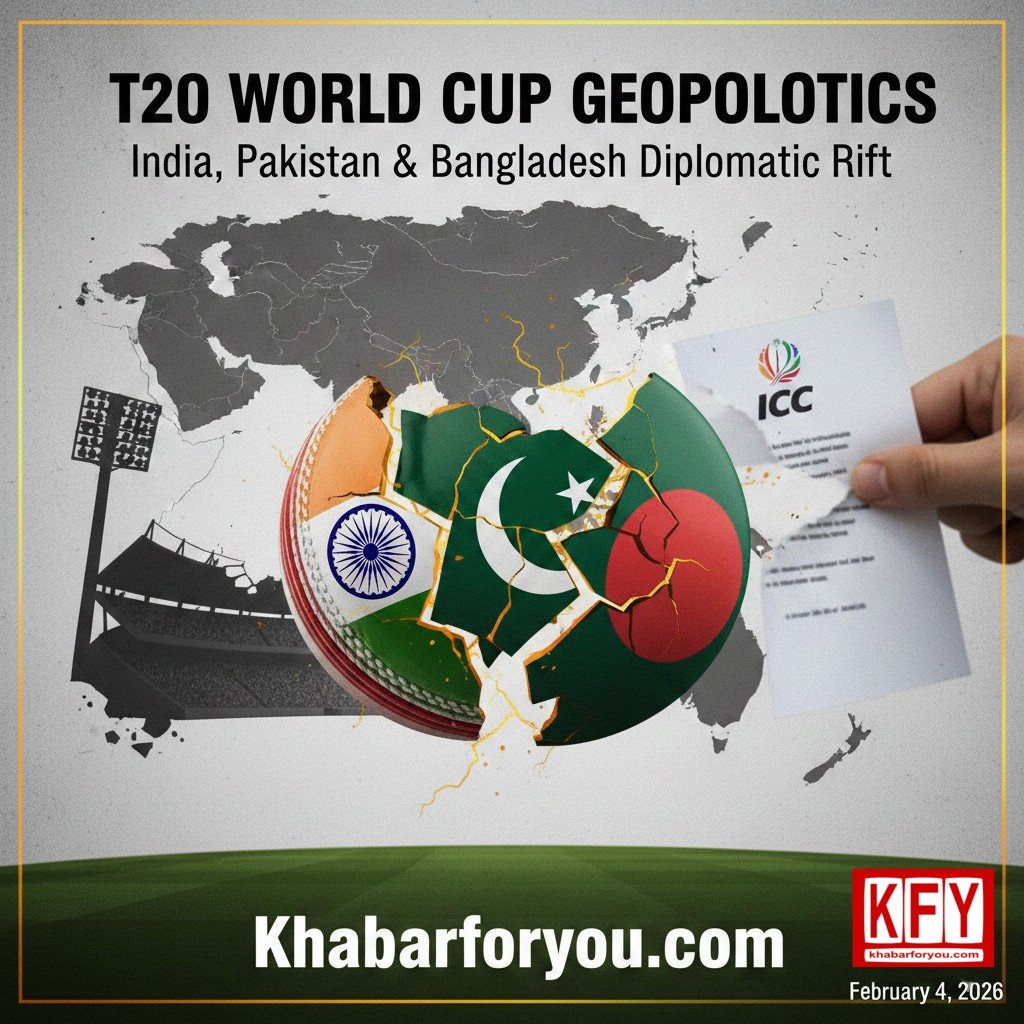
T20 World Cup Geopolitics: India, Pakistan & Bangladesh Diplomatic Rift | Khabar For You
- ASHOK KUMAR
- 04 Feb, 2026
- 100450

Email:-AKP00199824@gmail.com
Instagram:-@MR_ASHOK.024

Explore the deep-seated diplomatic tensions threatening the ICC T20 World Cup. From the IPL snub of Mustafizur Rahman to the India-Pakistan-Bangladesh standoff, we analyze the fractured state of Asian cricket and regional diplomacy.
Read More - India-US Trade Deal: $500B Investment & End of Russian Oil Purchases | Khabarforyou.com
A Subcontinent Divided by the Gentlemen’s Game
The sport of cricket, often deified as a secular religion in South Asia, has historically functioned as both a bridge and a battering ram in the region’s volatile geopolitics. However, as the ICC T20 World Cup 2026 approaches, the pitch has become less a field of play and more a theatre of sophisticated political posturing. What began as a franchise-level dispute has metastasized into a tripartite diplomatic standoff, leaving the ideal of Asian solidarity in tatters. The current impasse between India, Pakistan, and Bangladesh is not merely a logistical nightmare for the International Cricket Council (ICC); it is a sobering manifestation of how deeply the "gentlemen’s game" has been subsumed by the logic of the national security state.
The Catalyst: A Domino Effect in the Dugout
The immediate genesis of this crisis was deceptively parochial: the omission of Bangladeshi pacer Mustafizur Rahman from the Kolkata Knight Riders (KKR) roster for the 2026 Indian Premier League (IPL) season. While player rotations and auctions are ostensibly governed by "cricketing merit," the context of Rahman’s exit was inescapably political. Coming on the heels of deteriorating bilateral ties and a shift in Dhaka’s diplomatic posture, the perceived "snub" of Bangladesh’s premier fast bowler—orchestrated, many believe, under quiet directives from the Indian cricket establishment—acted as the catalyst for a diplomatic domino effect.
Dhaka’s response was swift and retaliatory. The subsequent ban on IPL broadcasts within Bangladesh was the first salvo in a broader campaign to assert national dignity against what it termed "institutionalized exclusion." This friction quickly transcended the commercial confines of the IPL, bleeding into the scheduling of the T20 World Cup. When the Bangladesh Cricket Board (BCB) formally refused to travel to India, citing a "verifiable lack of security" and a "hostile climate," the regional equilibrium collapsed.
The Standoff: Boycotts and Tactical Alignments
The standoff attained a new level of complexity when Pakistan entered the fray. In a move of calculated opportunism, the Pakistan Cricket Board (PCB) announced a boycott of its high-stakes group match against India, scheduled for Colombo. By refusing to face its arch-rival on Sri Lankan soil, Islamabad has effectively performed a pincer movement: it has signaled its solidarity with Dhaka while simultaneously protesting India’s long-standing refusal to travel to Pakistan for the Champions Trophy.
This "selective participation" has placed the ICC in an unenviable position. The tournament’s integrity is now under siege, not by the vagaries of weather or player fitness, but by the rigidities of state policy. Bangladesh’s insistence on a neutral venue and Pakistan’s subsequent walkout from the "marquee" fixture represent a rejection of the status quo where India’s administrative and financial hegemonies dictate the terms of engagement.
Historical Resonance: Partition’s Long Shadow
To understand the intensity of this rift, one must look beyond the boundary ropes to the foundational traumas of 1947 and 1971. The current friction is a contemporary re-enactment of the ancient tension between "religious brotherhood" and "linguistic nationalism."
The 1947 Legacy: The India-Pakistan rivalry remains rooted in the unresolved grievances of Partition, where cricket matches are often framed as "wars without the shooting."
The 1971 Paradox: Bangladesh’s current alignment with Pakistan - historically its oppressor - against India - once its liberator - highlights a significant shift. The shared "religious brotherhood" that once failed to hold the two wings of Pakistan together is now being leveraged as a diplomatic tool against an Indian administration perceived as increasingly exclusionary.
Conversely, the "linguistic nationalism" and cultural affinity that once bound West Bengal and Bangladesh have been eroded by a hardening of borders and a rising tide of majoritarian rhetoric. The sport has ceased to be a conduit for "people-to-people" contact; instead, it has become a metric for measuring national grievance.
Institutional Critique: The Commercialization of Discord
The ICC and its primary broadcasters cannot escape a stinging critique in this debacle. For years, the global governing body has prioritized "commercial windfalls" over diplomatic stability. The scheduling of ICC events has become a cynical exercise in ensuring that India and Pakistan are funneled into the same group, guaranteeing a windfall in television ratings and advertising revenue.
By treating the India-Pakistan clash as a guaranteed "cash cow," the ICC has neglected the structural health of the game in Asia. This obsession with revenue has empowered national boards to use these high-value matches as leverage. When the "hybrid model" was introduced to accommodate India’s refusal to travel to Pakistan, it set a precedent of exceptionalism that other boards are now, quite logically, seeking to exploit. The ICC’s failure to establish a firm, neutral protocol for venue selection has allowed the sport to be hijacked by domestic political agendas.
The Long-term Implications: A Continent Adrift
The implications for the future of Asian cricket are grim. We are witnessing the erosion of the "Asian bloc," which once acted as a formidable counterweight to the traditional powers of the sport. If the continent’s three major powers cannot agree on the basic sanctity of a world tournament, the region risks losing its status as the heartbeat of the global game.
Furthermore, the diplomatic cost is high. When cricket matches are cancelled or boycotted, the last remaining channel of "soft power" between these nuclear-armed neighbors is severed. The rhetoric of the stadium is increasingly indistinguishable from the rhetoric of the war room.
Conclusion: Beyond the Boundary
The 2026 T20 World Cup was intended to be a celebration of the sport's expansion and vitality. Instead, it threatens to be remembered as the moment when regional chauvinism finally eclipsed athletic excellence. Unless there is a concerted effort by the ICC to decouple the game from the immediate whims of national governments - and a realization among the South Asian boards that they are destroying the very product they seek to protect—the future of the sport will remain as fractured as the subcontinent itself. The game requires a level playing field; currently, it is merely a battlefield.
Business, Sports, Lifestyle ,Politics ,Entertainment ,Technology ,National ,World ,Travel ,Editorial and Article में सबसे बड़ी समाचार कहानियों के शीर्ष पर बने रहने के लिए, हमारे subscriber-to-our-newsletter khabarforyou.com पर बॉटम लाइन पर साइन अप करें। |
| यदि आपके या आपके किसी जानने वाले के पास प्रकाशित करने के लिए कोई समाचार है, तो इस हेल्पलाइन पर कॉल करें या व्हाट्सअप करें: 8502024040 |
#KFY #KFYNEWS #KHABARFORYOU #WORLDNEWS
नवीनतम PODCAST सुनें, केवल The FM Yours पर
Click for more trending Khabar
Leave a Reply
Your email address will not be published. Required fields are marked *
Search
Category